


What is the horsepower output of an F1 power unit? In 2026, the answer is still over 1,000 horsepower combined. But how that power is made has changed completely. The gasoline engine still revs to 15,000 rpm, far beyond any road car, but it now shares the workload almost equally with a much larger electric motor.
F1 cars remain faster than Le Mans Hypercar (LMH) machinery. Valtteri Bottas set a faster lap at Monza in a 2021 F1 car than any LMH prototype has managed. The gap comes down largely to power: F1 cars produce over 1,000 hp, while LMH cars are capped at 500kW, or roughly 670 hp, under ACO/FIA endurance rules.
F1 Car Horsepower (2026):
- An F1 power unit produces over 1,000 hp in 2026, split near 50/50 between the combustion engine (~536 hp) and the electric MGU-K (~469 hp).
- The MGU-H has been eliminated for 2026 — only the MGU-K remains as the electric component.
- Minimum car weight in 2026 is 768 kg, giving a power-to-weight ratio of roughly 1.30 hp/kg.
- The most powerful F1 engine ever was the BMW M12/13/1 (1986), producing up to 1,350 hp in qualifying trim.
- F1 power isn’t capped directly in horsepower — it’s controlled indirectly via the 350kW MGU-K limit and a fuel-flow cap.
F1 Car Horsepower in 2026: The New 50/50 Power Split Explained
The 2026 rules mark the biggest power unit overhaul since the hybrid era began in 2014. The MGU-H, which recovered heat energy from the turbo, has been removed entirely. In its place, the MGU-K — the electric motor connected to the rear axle — has nearly tripled in output, jumping from 120kW (160 hp) to 350kW (469 hp).
To balance that surge in electric power, the internal combustion engine has been scaled back from around 550kW to roughly 400kW (536 hp). Combined output still tops 1,000 hp, but for the first time, the split between combustion and electric power sits close to 50/50, rather than the old package’s roughly 80/20 split in favour of the engine.
All 2026 cars also run on 100% advanced sustainable fuel, made from non-food biomass, municipal waste, or carbon capture. Fuel use has dropped too: the FIA now caps flow at 3,000 megajoules per hour, targeting around 70 kg of fuel per race, down from 100 kg in 2025.
F1 Car Horsepower and Torque: What the Numbers Really Mean
Horsepower only tells half the story. F1’s combustion engine hits peak power at extremely high RPM, but its torque figure alone is modest — well under what a large road-going diesel produces. The FIA regulations cap the MGU-K’s mechanical torque contribution at 500 Nm, delivered instantly and at any RPM.
That instant electric torque is why 2026 cars accelerate harder out of slow corners than any previous generation. Horsepower is simply torque multiplied by RPM, so an F1 engine leans on extreme revs to compensate for a torque figure a road supercar would consider unremarkable.
F1 Power-to-Weight Ratio: How Many HP per Kg in 2026?
Power-to-weight ratio is arguably the truest measure of an F1 car’s performance. The 2026 minimum weight is 768 kg, down 30 kg from the 798 kg minimum used in 2025. Combined with over 1,000 hp, that works out to roughly 1.30 hp per kg, or about 1,300 hp per tonne.
For comparison, a Bugatti Chiron Super Sport — one of the most powerful road cars ever built — produces 1,600 hp for a kerb weight of around 1,995 kg. That’s roughly 0.80 hp per kg, meaning an F1 car still out-punches it by a wide margin despite the Chiron’s raw power figure.
Factors Contributing to F1 Cars’ High Horsepower
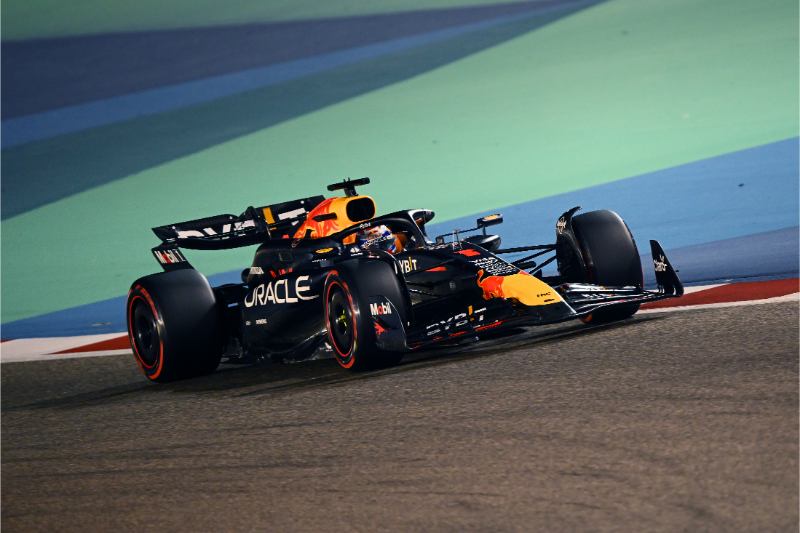
The single biggest factor is the hybrid architecture itself: a 1.6-litre V6 combined with a powerful electric motor, working together rather than the electric side simply topping up the engine. That combination is what lets F1 hold over 1,000 hp despite a smaller, more fuel-efficient engine than road-car V8s of a similar era.
The other factor is car weight. At just 768 kg minimum, an F1 car pairs its power with a chassis far lighter than any comparable performance car, pushing the power-to-weight ratio well past anything on public roads. Together, weight and hybrid power let these cars reach speeds beyond 350 km/h.
Is There an Official Horsepower Limit in F1?
There’s no direct horsepower cap written into the FIA rulebook. Instead, power is controlled indirectly, through a handful of tighter limits: engine capacity fixed at 1,600cc, a 15,000 rpm rev ceiling, a 350kW hard limit on the MGU-K, and the new 3,000 MJ/h fuel-flow cap that replaced the old fuel-mass limit.
That combination of rules is precisely why every hybrid-era F1 power unit, from 2014 through 2026, has landed in roughly the same 1,000+ hp window, even as the split between combustion and electric power has changed dramatically.
The Most Powerful F1 Engine Ever Made
In 1986, BMW built the most powerful F1 engine in history: the M12/13/1, a turbocharged four-cylinder capable of an estimated 1,350 hp in qualifying trim, though the exact figure was never officially confirmed by BMW. In race trim, output was dialled back to around 900 hp to preserve reliability over a full Grand Prix distance.
The Benetton B186 used this engine during the 1986 season, at the peak of F1’s unrestricted turbo era. No power unit since has been credibly reported to exceed that qualifying-mode figure, even with today’s hybrid systems pushing well past 1,000 hp.
F1 Horsepower by Era: A Comparative Table
| Era | Engine | ICE Power | Electric Power | Total Power | Min Weight |
|---|---|---|---|---|---|
| 1980s Turbo | BMW M12/13/1 (example) | ~900 hp race / ~1,350 hp quali | None | ~900–1,350 hp | ~540 kg |
| V10 NA (1995–2005) | Ferrari / Mercedes V10 | ~950–980 hp | None | ~950–980 hp | ~600 kg |
| V8 NA (2006–2013) | Various 2.4L V8s | ~750–780 hp | KERS (60 kW) | ~750–780 hp | ~642 kg |
| Hybrid Gen 1 (2014–2025) | 1.6L V6 Turbo + MGU-H/K | ~750 hp | ~160 hp (120 kW) | ~1,000 hp | 798 kg (2025) |
| Hybrid Gen 2 (2026+) | 1.6L V6 Turbo + MGU-K | ~536 hp (400 kW) | ~469 hp (350 kW) | 1,000+ hp | 768 kg |
F1 vs. Road Cars: A Horsepower and Weight Comparison
Comparing F1 to road cars is close to comparing different categories of vehicle entirely. A typical road car sits somewhere between 100 and 400 hp, with a power-to-weight ratio well under 0.25 hp/kg. F1 cars, by contrast, exceed 1,000 hp at 768 kg — a ratio of roughly 1.30 hp/kg.
Even the fastest hypercars can’t fully close that gap. A Bugatti Chiron Super Sport manages around 0.80 hp/kg, still well short of an F1 car. That difference in ratio, more than horsepower alone, is why F1 cars reach speeds beyond 350 km/h while most road cars are electronically limited to around 250 km/h.
The Evolution of F1 Car Engines
F1 engine architecture has shifted dramatically across the decades: from the unrestricted 1.5-litre turbo engines of the 1980s, through naturally aspirated V10s and V8s in the 1990s and 2000s, to the 1.6-litre V6 turbo hybrid introduced in 2014 and now reworked again for 2026 with a far more powerful electric system.
Each era’s engine rules have shaped the wider car around them, from chassis weight to aerodynamics. Total performance still depends on far more than the engine alone — chassis design, aerodynamics, and driver skill all play a part in translating raw horsepower into lap time.
FAQ: F1 Car Horsepower
Over 1,000 hp — approximately 536 hp from the 1.6L V6 combustion engine (400kW) and 469 hp from the electric MGU-K (350kW), a near 50/50 split. The MGU-H has been eliminated for 2026.
With a minimum weight of 768 kg and over 1,000 hp, the ratio is roughly 1.30 hp/kg — more than 1.5 times that of a top hypercar like the Bugatti Chiron Super Sport.
The combustion engine alone produces relatively modest torque at high RPM. The MGU-K adds instant electric torque, capped at 500 Nm by FIA regulations, boosting corner-exit acceleration.
No direct cap exists. Power is controlled indirectly through a 350kW ceiling on the MGU-K, a fixed 1,600cc engine capacity, and a fuel-flow limit of 3,000 MJ/h introduced in 2026.
The BMW M12/13/1 (1986), used in the Benetton B186, is estimated to have produced up to 1,350 hp in qualifying trim — the highest figure widely reported in F1 history.