

Lando Norris has apologised to Franco Colapinto. The McLaren driver had called for a race ban after their Azerbaijan Grand Prix ended in a restart crash. Two days later, he admitted his driver comments went too far.
Lando Norris was furious after Franco Colapinto locked up at Turn 1 on lap 36, triggering a pile-up that eliminated both drivers and Alpine team-mate Pierre Gasly. The incident came at a safety-car restart on Baku’s slippery street circuit, where grip remained scarce and the field had to judge its braking carefully. Norris told reporters that the FIA should start issuing bans for this kind of crash, then argued that Colapinto should not be in Formula One. He also said a driver responsible for a restart collision should receive at least a one-race suspension.
After taking time to reflect, the reigning world champion contacted Colapinto privately and apologised, saying emotion did not excuse his words. The exchange brings a personal note to a motorsport controversy that quickly spilled beyond the paddock, with the Argentine facing online abuse. Colapinto accepted responsibility for what he called a big mistake, while Alpine boss Flavio Briatore was left angered by a crash that cost the team a possible double points finish. The apology changes the tone of the story, but leaves wider questions about penalty consistency and driver conduct in the spotlight.
Norris apologises after Baku restart crash with Colapinto
The collision unfolded as the pack accelerated away from the safety car. Colapinto locked his brakes approaching the first corner and ran into the unfolding traffic, taking out his own Alpine, Gasly’s car and Norris’s McLaren. Norris emerged from the incident with no chance to continue and said his car parts had been left unusable.
His immediate reaction was blunt. Norris argued that drivers should anticipate low grip at a restart, and said the FIA should respond more harshly when a mistake removes several cars. He had not yet reviewed the incident when he spoke, a detail that matters: the comments came in the heat of a race-ending crash, rather than after a full examination of the footage.
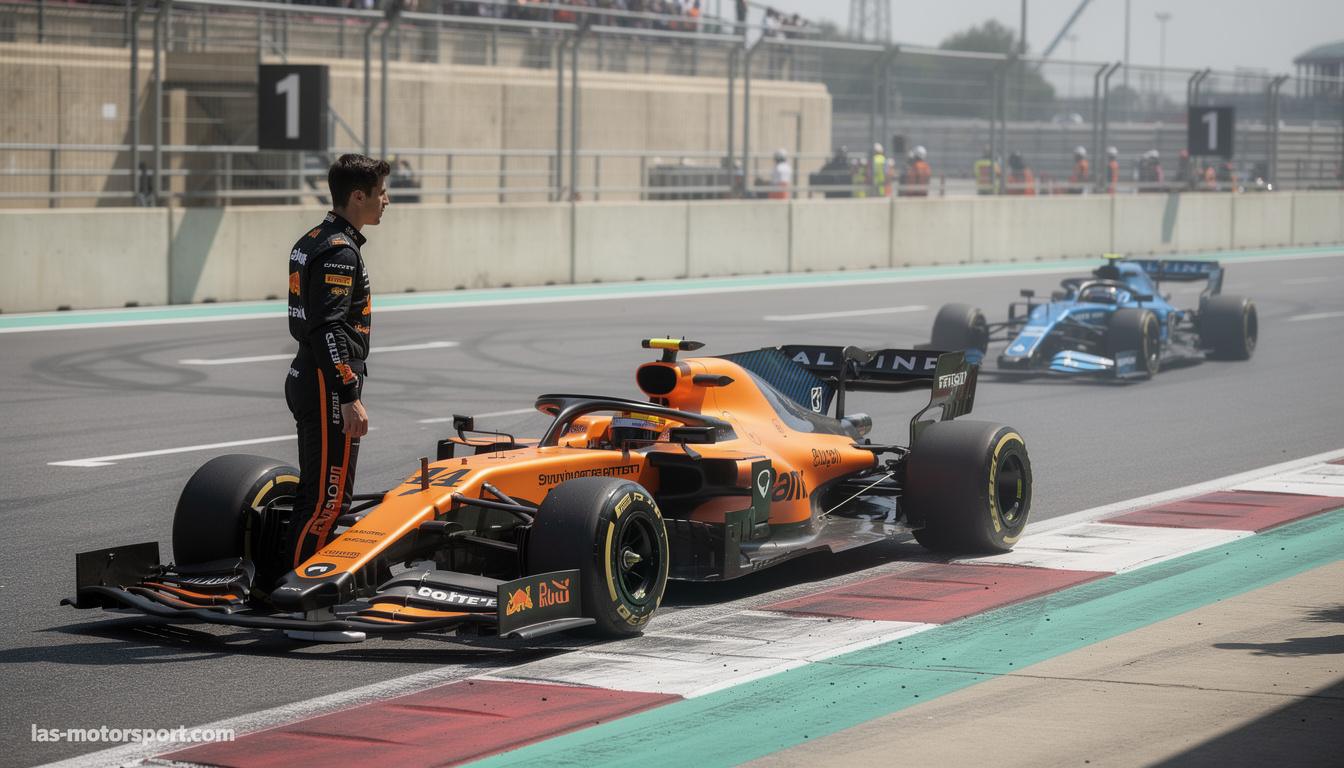
Race ban demand becomes an apology to Colapinto
In his social media statement, Norris called the weekend tough and described the early race exit as disappointing. He said he had messaged Colapinto to apologise, acknowledged that he should have chosen his words better, and accepted that racing on the limit brings mistakes. Norris added that the two had reached a good understanding and remained friends ahead of the next race.
The change in tone was clear: Norris no longer framed the crash as grounds for a race ban. That does not erase the initial outburst, but it shows a driver recognising the gap between frustration and a fair judgement of another competitor. Readers can follow Norris’s F1 career and the wider fallout from online abuse as the story develops.
What the Baku crash means for F1 penalties and driver conduct
The technical context helps explain the split between blame and consequence. A restart compresses the field, while a slippery surface narrows the margin for error into a heavy braking zone; a lock-up at Turn 1 can quickly turn one driver’s mistake into a multi-car incident. Norris argued that Formula One drivers must anticipate those conditions, while Colapinto’s acceptance of responsibility signals that he understood the cost of his misjudgement.
Whether the stewards’ penalty matched the incident is separate from Norris’s call for a suspension; the supplied information does not establish a race ban. That distinction matters in a sport where sanctions must account for both the outcome and the circumstances, rather than the damage alone. For Alpine, the lost double points chance sharpens the sporting cost; for McLaren, it ended Norris’s race. The apology closes one personal chapter, while the debate over consistent F1 driver conduct remains open.
For more F1 news and paddock analysis, the episode offers a reminder of how quickly an on-track error can become a public dispute. Norris has withdrawn the demand; Colapinto has owned the mistake. The next test is how both drivers respond when the lights go out again.