
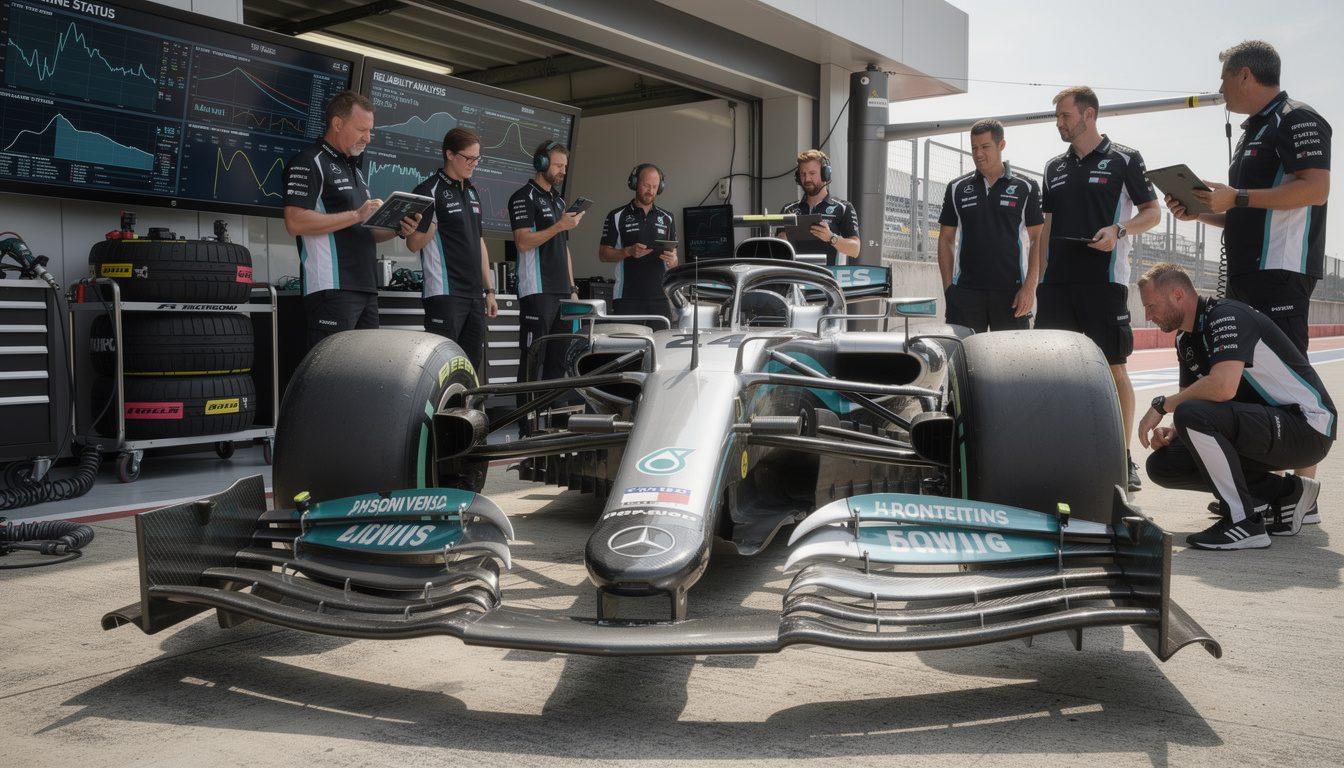

The controversy surrounding Mercedes’ two-phase front wing activation system is capturing attention. Here, you’ll discover that this feature is not a trick to bypass the rules, but rather a technical challenge related to reliability. The debate over this innovation in aerodynamics reflects the intensity of research in Brackley to optimize every detail.
Technical precision in front wing aerodynamics plays a crucial role in Formula One performance. Mercedes has recently confirmed that its two-phase front wing activation stems from a reliability issue, not from regulatory exploitation. To explore this topic further, check out our analysis of recent innovations in F1 aerodynamics.
Decoding the “Two-Phase” mechanism in Formula One

Mercedes faced questions regarding the specific functioning of its system. During the Chinese Grand Prix, the front wing shifted position in two stages, which caught the attention of several rival teams. This sequence occurred outside the 400-millisecond regulatory window imposed by the FIA. A hydraulic issue was identified, causing a slow return to the angle mode.
Managing aerodynamic modes during a race requires extreme precision in wing activation timing. An erratic command generates a negative effect on aerodynamic stability, impacting handling through corners. Mercedes views this incident as a source of performance loss and is working to correct it quickly. The FIA has validated this explanation, avoiding any dispute over a potential breach of the rules.
Implications for competitiveness and FIA regulations

The situation surrounding this system highlights the importance of complying with limitations on aerodynamic actions in F1. The regulations allow a single transition between two aero modes within a maximum of 400 milliseconds. Mercedes did not intentionally exceed this limit but was affected by it due to a technical issue. This situation illustrates the fine line between innovation and regulatory constraints in the pursuit of performance.
Rival teams, while concerned about technical transparency, acknowledge that the issue in question provides no advantage. The FIA closely monitors and documents this type of development to adjust the rules if necessary. You can also read about the importance of technical scrutineering in F1 in our other reports. This vigilance strengthens the credibility of competitions while preserving the spirit of fair play.