
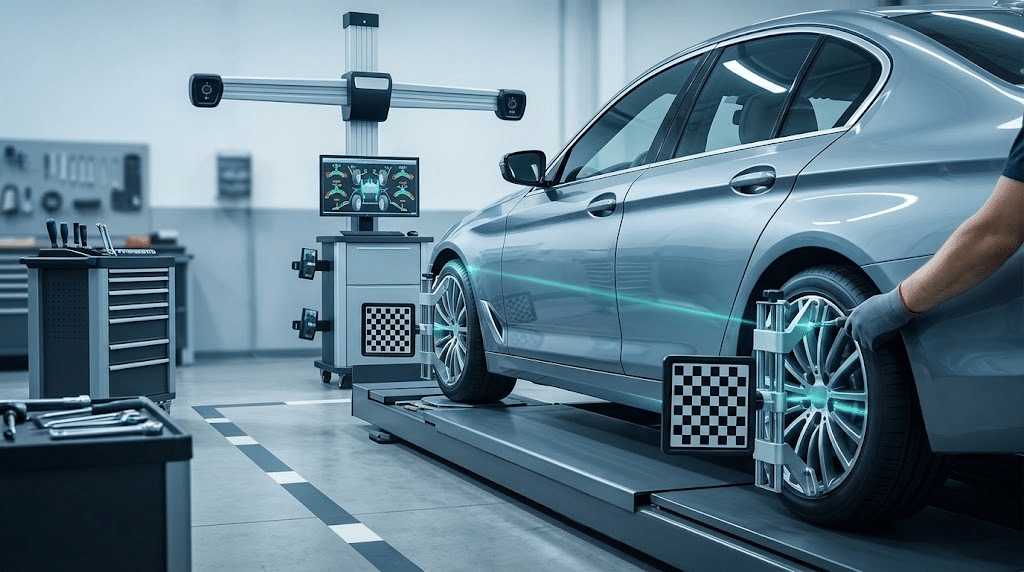

Every vehicle that rolls into a service bay carries a story written in its tires. Uneven wear patterns, a car that pulls to one side, or a steering wheel that sits slightly off-center are all clues pointing to the same underlying issue: misalignment. Fixing that problem correctly depends less on the mechanic’s experience alone and more on the equipment doing the measuring. This is where alignment machines, including systems like wheel aligners, play a central role in modern automotive service. The accuracy of these machines determines whether a repair actually solves the problem or simply masks it for a few thousand miles.
Wheel alignment is often treated as a routine maintenance task, but the physics behind it are anything but simple. A vehicle’s suspension geometry involves multiple angles working together with camber, caster, and toe, each affecting handling, tire wear, and fuel efficiency in different ways. Getting these angles right requires tools capable of measuring fractions of a degree with consistency, which is a demanding technical standard for any piece of shop equipment to meet.
The Mechanics Behind Alignment Accuracy
Alignment machines work by measuring the angles of a vehicle’s wheels relative to each other and to the vehicle’s centerline. Older systems relied on manual gauges and visual estimation, which introduced significant room for human error. Modern machines, by contrast, use sensors, cameras, or laser-based systems to capture precise angular data and translate it into readable measurements on a screen.
The three primary angles measured are:
- Camber — the inward or outward tilt of the wheel when viewed from the front of the vehicle
- Caster — the forward or backward tilt of the steering axis, which affects steering stability
- Toe — the direction the wheels point relative to each other, measured from above
Even small deviations in these angles compound over time. Research from the Tire Industry Association has noted that a toe misalignment of just a fraction of an inch can accelerate tread wear substantially over the life of a tire, sometimes reducing usable tread life by 10 to 15 percent. That kind of measurable impact is why the equipment used to detect and correct these angles matters as much as the technician’s skill in interpreting the results.
Why Equipment Quality Directly Affects Outcomes
Accurate wheel alignment depends not only on technician skill but also on the quality of the measurement equipment being used. Modern systems are designed to capture precise suspension and wheel-angle data so technicians can make adjustments based on consistent measurements rather than visual estimates or basic mechanical checks.
Professional systems such as John Bean wheel aligners use imaging and diagnostic technology to support accurate alignment measurements across a range of vehicles. Certain models also include automatic camera tracking and monitoring features that can identify conditions capable of interfering with the alignment process, helping technicians recognize potential errors before adjustments are completed.
Reliable equipment therefore plays an important role in producing repeatable results. Even experienced technicians depend on accurate measurements to determine whether toe, camber, caster, and other alignment angles are within the appropriate specifications for the vehicle.
The Cost of Getting Alignment Wrong
Misalignment doesn’t just cause premature tire wear — it has downstream effects on fuel consumption, braking performance, and overall vehicle safety. The U.S. Department of Energy has estimated that proper alignment and tire maintenance can improve fuel economy by a measurable margin, since misaligned wheels increase rolling resistance and force the engine to work harder to maintain speed.
Beyond fuel efficiency, there’s a safety dimension that’s easy to underestimate. A vehicle pulling to one side under normal driving conditions may require constant steering correction, which becomes a meaningful hazard during sudden maneuvers or emergency braking. Suspension components also bear uneven stress when alignment is off, which can shorten the lifespan of ball joints, tie rods, and bushings — parts that are considerably more expensive to replace than the cost of a proper alignment service in the first place.
In the middle of all this, the role of dependable alignment equipment becomes clear. Shops that invest in well-calibrated systems, including options like John Bean wheel aligners, are better positioned to catch subtle misalignments before they escalate into costly mechanical problems. It’s not about brand loyalty — it’s about the measurable difference that precise instrumentation makes in diagnostic accuracy.
How Alignment Technology Has Evolved
The alignment equipment used decades ago bears little resemblance to what’s found in shops today. Early systems relied on bubble levels and string measurements, methods that depended heavily on a technician’s steady hand and careful eye. As vehicles became more complex — with independent suspension systems, all-wheel-drive configurations, and advanced driver-assistance sensors that require recalibration after alignment work — the tools needed to keep pace.
Today’s systems typically fall into a few categories:
- Laser-guided systems, which project beams onto reflective targets attached to the wheels to calculate angles
- Camera-based systems, which use imaging sensors to track target positions in three-dimensional space
- CCD (charge-coupled device) systems, an earlier digital approach still used in some shops, relying on sensor arrays to detect angular changes
Each approach has tradeoffs in terms of setup time, calibration needs, and sensitivity to shop conditions. Camera-based systems, for instance, tend to offer faster setup but require a clear, unobstructed line of sight, while laser systems can be more resilient to certain lighting conditions but may need more frequent target calibration.
What This Means for Everyday Vehicle Owners
Most drivers won’t interact directly with alignment machines, but the quality of the equipment used during a service visit still affects them in tangible ways. A properly aligned vehicle handles predictably, wears tires evenly, and places less strain on suspension components. These outcomes trace back to whether the shop’s equipment was capable of producing accurate readings in the first place.
For vehicle owners, a few practical takeaways are worth keeping in mind:
- Tire wear patterns are often the earliest visible sign of alignment issues
- Alignment should typically be checked whenever new tires are installed or after hitting a significant pothole or curb
- Asking whether a shop’s equipment is regularly calibrated is a reasonable question, not an unusual one
Final Analysis
Precision in vehicle alignment isn’t an abstract technical detail — it has real, measurable consequences for tire longevity, fuel efficiency, and driving safety. The equipment behind the process, whether it’s a laser-based system, a camera-guided setup, or systems like John Bean wheel aligners, determines how reliably those small but critical angles are measured and corrected. As vehicles continue to grow more complex, the demand for accurate, well-maintained alignment equipment will only increase. Understanding this connection helps explain why alignment work, often seen as routine, actually depends on some of the more sophisticated measurement technology found in an auto shop.